
Trading Soybeans for Computers
It's not just the trade deficit with China, it's the technological trade deficit.

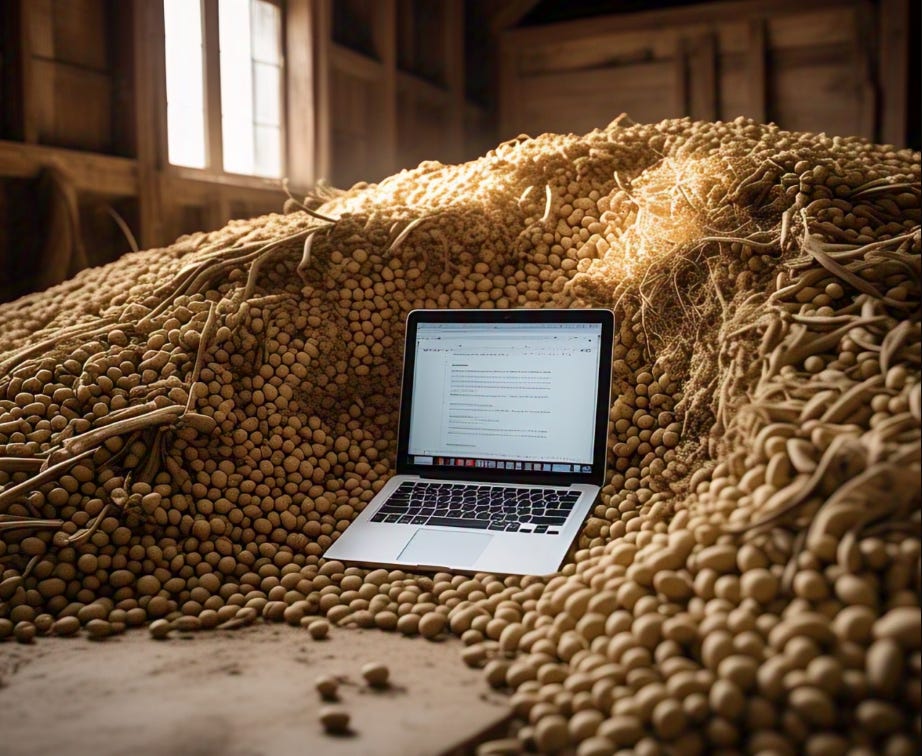
America has a $295 billion trade deficit with China, but the bigger problem may be the technological imbalance between what we are importing and what they are exporting.
It's not just the trade deficit with China, it's the technological trade deficit.
The majority of our exports to China are raw products like petroleum and soybeans, the two largest categories being exported, while the majority of China’s exports to the United States are manufactured products like computers and other technical equipment.
We send corn and sorghum to China, they ship us back batteries and toys. We sell them coal and ores, they sell us circuit boards and car parts. We ship them tanned hides and meat, and then receive back optical fibers and medical equipment.
Advanced societies buy raw resources from backward societies and sell them back the manufactured goods. We export scrap metal to China, they send us back steel. We send them scrap copper, they ship us back the equipment of which that copper is a component. We export polymers and import the finished ‘Made in China’ plastic products that fill up our stores.
The $295 billion trade deficit between America and China reflects the fact that much of what we ship to China is crude and therefore cheap while what China sells us is more finished and therefore also more expensive. And so our exports to China in 2023 amounted to $154 billion while theirs amounted to $436 billion.
But that’s what happens when nearly 9% of China’s exports are computers while 9% of our exports are soybeans. What’s the value of a bushel of soybeans against a Lenovo laptop?
When it comes to China, we function like a third world economy selling raw resources and then buying them back at a hundred or thousand times the price. And a third world economy is bound to have a massive trade deficit with a third world economy because it’s higher end.
England set up its American colonies to obtain raw resources to turn into finished products. One of the causes of the American Revolution was our refusal to be satisfied with the dirty work of harvesting cotton and tobacco by the crudest means possible and then shipping them on to England. America used tariffs to build up its own manufacturing and became independent.
Now we have been set back to the era of colonial dependency. We have become the cheap labor that China uses to extract resources from American territory for its manufacturing.
Unlike the United States, China’s disproportionate dominance of trade balances around the world is not a byproduct of a booming domestic product sector. America’s GDP far outstrips China’s. Average salaries in China are barely a fifth of those in the United States.
And, most damningly, private consumption as a percentage of the GDP is a minority in China, and a majority in America, nearly double what it is in Communist China.
China isn’t a consumer economy with exports, it’s a parasitic export economy that suppresses domestic consumption with high consumer taxes. During the pandemic, America focused on stimulating consumer spending while China ignored individual citizens to boost manufacturing.
In America, consumer spending drives growth whereas in China’s Communist system, consumer spending is an inconvenience that siphons off products meant for foreign exports.
The Trump administration is being accused of setting off a trade war with China, but China’s entire economy is one big trade war against America and the entire world. Unlike Japan or South Korea, China is not trying to build up a middle class and views domestic consumption of its own products as a necessary evil at best and as capitalistic excess at worst.
China did not become a capitalistic system. Instead it demonstrated a thorough commitment to Communism’s obsession with industrial development. The lesson its leaders learned from the fall of the Soviet Union was that its industrial production had to be funneled into consumer goods to pacify the population and, more importantly, to win a trade war with the West.
Like the USSR, China is equally obsessed with building for the sake of building. It constructs ghost cities, massive bridges, roadways to nowhere and rapid trains, not because they are genuinely needed, but because the manic state of Communism requires constant building.
China’s anthill cities rise with no real purpose except to bring the entire population into collective megalopolises where they can be thoroughly controlled and monitored at all times. Its real estate crisis is not a private sector failure but the conjoining of the oligarchy and the regime which are both obsessed with land and dynasties for reasons that are largely traditional.
These mad empires are sustained with an equally mad export industrial complex that illegally ships everything from knockoff handbags to fentanyl and ‘legally’ copies and buries us in cheaper and worse versions of our own products whether physical or digital to win at any cost.
And not just us.
Given time, China can figure out how to copy anything, from vacuum cleaners to cars to apps like TikTok and AI like DeepSeek and make it more cheaply. The advantage of depressing your own domestic consumer economy is that wages are lower and while many Chinese workers may not be able to afford the products they make for export, the regime likes it that way.
TikTok is meant to poison America, but it’s forbidden in China. Even as Chinese companies invest in gaming, the regime domestically restricts it. It has no more interest in corrupting its own citizens than in peddling the fentanyl that it sells to Americans on the streets of its own cities.
This isn’t a trade war. It’s a war carried on using trade as the ultimate weapon.
How can America win a trade war with China? Sometimes the only way to win a game is not to play. As long as China’s economy is geared toward buying our resources and selling us their manufacturing, we not only lose, but we become a third world country in the process.
America was built on tariffs and trade wars. Without them, we would have been a third world country. With them, we can start rebuilding our economy and our nation.
Daniel Greenfield is a Shillman Journalism Fellow at the David Horowitz Freedom Center. This article previously appeared at the Center's Front Page Magazine.
It's a complex problem. I'm not sure tariffs and trade wars are enough to solve it. There's the decadent American educational system. For every American student majoring in "gender studies" or similar vacuous subjects there are 5 Chinese students majoring in STEM. God forbid an American student should have to learn calculus, linear algebra, or C++ programming.
Interesting article. I agree with much of the diagnosis, i.e. Western economic dependence on China is undoubtedly a serious vulnerability. But I think the analysis would benefit from paying closer attention to the role of financialisation. This wasn’t only the result of cultural decline or ideological confusion; it was, above all, the logical outcome of a financial system that rewards short-term returns over strategic thinking.
It’s important to acknowledge that Western corporations and financial elites actively pursued this offshoring, not because they were tricked or coerced, but because they prioritised quarterly profits and asset prices over industrial resilience. In that sense, the West was not simply a victim of Chinese predation, but a willing participant in its own vulnerability.
None of this excuses China’s behaviour, but it does complicate the story. Unless we understand that the problem is not only “out there” but deeply embedded in our own economic model, any attempt at decoupling (if that is even realistic) will be politically difficult and economically painful.